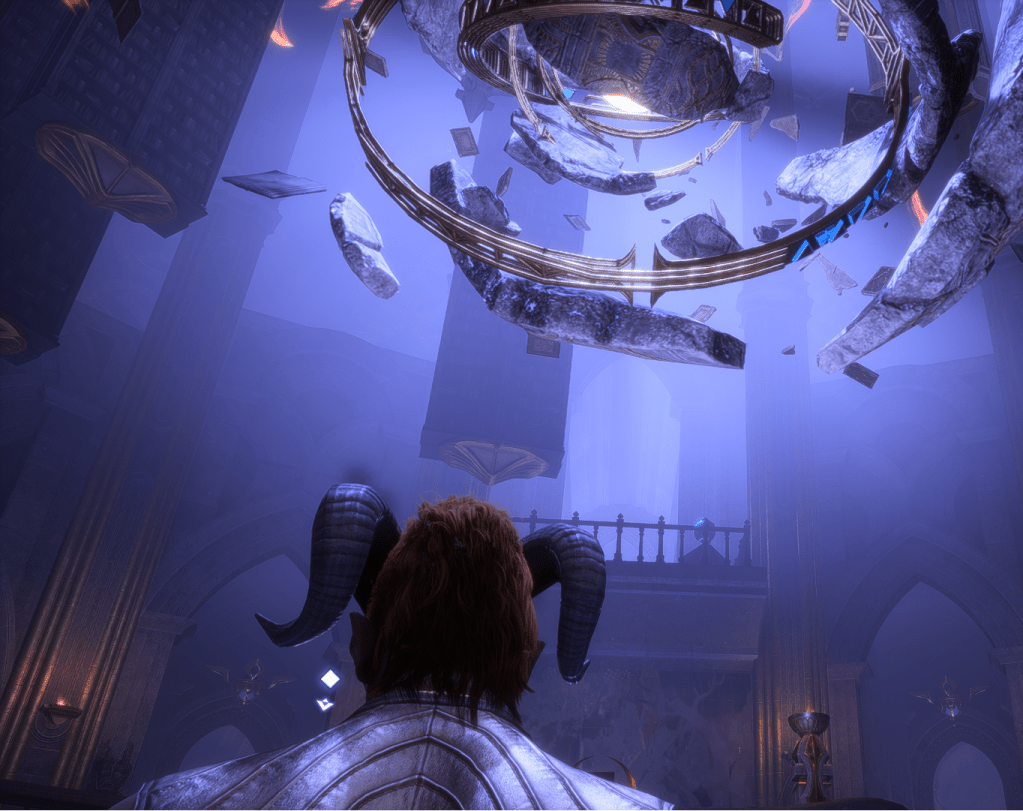
I finally finished my first playthrough of Dragon Age: The Veilguard and I have thoughts.
First off, I’m going to avoid giving away too many specifics. If you want to know what happens, there are plenty of discussions and gameplay videos to spoil the story for you. I prefer to avoid giving away details by way of the River Song proclamation: no spoilers, sweetie.
Nonetheless, even discussing the shape of the ending will probably allow someone to draw some conclusions about specifics. And there’s no discussion at all without giving at least some general idea of the directions things take.
And I’ll be discussing mechanics, skill trees and the UI right out in the open.
Last things first: An absolutely epic ending
When I started the “point of no return” quest that began the end game, I figured it was going to be one or two big fights and then the typical Bioware payoff: a party where you get to have last words and share congratulations with all your companions like in Inquisition. Instead, I found several more hours of pretty intense gaming and story development.
Honestly, the Veilguard end game is one of the best endings I’ve played in a long time. You level up fairly quickly in Veilguard, but I was still surprised to find myself going up an additional three levels between accepting the point of no return quest and then finishing the last big battle. There are a lot of things going on here with much back and forth between gameplay and cut scenes.
As I’ve been comparing Veilguard to Mass Effect 2 since well before it came out, I was perhaps a little smug when it turns out the ending of Veilguard unwinds in much the same way that ME2’s does. Whether or not you’ve ever played Mass Effect 2, the basic things to remember when approaching the Veilguard end game are these: be prepared, and choices really do matter.
I had a blast playing through, thinking that each time I turned a corner the last battle would be there, but it just kept going. Story lines wrapped up – some in truly unexpected ways, but more about that below. It was an epic slog and I loved every minute of it.
Right up until the party returned to loud cheers from the masses and then the party started. Except no. That didn’t happen at all. There were loud cheers from the crowds, and then… credits?
You don’t even get to conclude things with your companions. No saying your last goodbyes or asking what they might be doing next. No final tender moments with your character’s beloved (should you have decided to pursue one). Just a speech by several characters, including Rook, making it very clear that Veilguard is indeed a changing of the guard for the Dragon Age series.
After all that – pretty much two weeks of my life devoted to these characters and being a long-time BioWare RPG fan – I felt very much like I’d gone to dinner at an old friend’s house to catch up on each other’s lives, but was unceremoniously and unexpectedly handed my coat and pushed out the door just before dessert was served.
Still, if I need motivation to see myself through another campaign, the Veilguard end game is it. Just like ME2, it’s an end game that gives satisfaction in play and also in providing outcomes based on how well you’ve prepared. Assuming you’ve prepared well (which isn’t really difficult), watching the parts of the ending delivered as cut scenes is extremely satisfying.
I can’t recommend the Veilguard end game enough is my point, I guess. Just be prepared for a lack of emotional payoff or in-game postmortem.
Mechanics
I’ve struggled with the mechanics of Veilguard throughout. It took me a while to understand why the keybindings were what they were. I would have changed a few, but I couldn’t think of better keys to assign. And once I got it through my thick head that the shift key was just turbo-everything things got easier.
Still, the dodging and sprinting during combat seem very sticky to me and I continued feeling a little bit like I was running through water and having to spin across a battlefield like Yoda in those Star Wars films just to stay out of harm’s way.
The most important thing about Veilguard difficulty levels is this: they can be fully adjusted. BioWare now refers to difficulty levels in terms of presets (maybe it did before and I never noticed) and then offers a fully customizable set of advanced settings to fine tune your experience to match your skill and comfort level.
For instance, I found the aggression from enemy combatants to be excessive. I’m not the only one as I’ve seen multiple people talk about it in the Steam forums. Well, had I bothered to explore the UI a bit further, I would have noticed that under the Advanced Settings option, one can adjust the aggro of enemies.
There are like six difficulty presets, and then a whole panel of adjustments. Which is great. A few times I dropped down to “Keeper” or even the story mode just due to the aggro of enemies that were gigantic and downed me with just a few almost unavoidable attacks. This was a little frustrating as the default difficulty preset (“Adventurer” I think) was in other ways perfect for the first campaign. I rarely go in for difficult modes in RPGs. Usually, the normal difficulty setting ends up being just about perfect for my skill level.
It’s really nice to have all these fine tuned options, though. I can push the envelope in some areas and then cut myself some slack in others.
Being able to tune the difficulty options makes dealing with the subpar dodge and sprint abilities much more manageable. The rest of the combat mechanics are pretty fun to play, but definitely a departure from previous Dragon Age games.
There are relatively few combat actives in the skill trees, with most of the perks being passive enhancements. I honestly couldn’t tell how it stacks up against prior DA games, but it felt like there were fewer options. There is a lot more emphasis on jumping around in combat. Several skill tree perks give bonuses for mid-air attacks, as do several pieces of equipment. The jumping around in combat is really the Yoda-esque dodging skill. You combine the dodge with an attack, and you have offense and defense at the same time.
Longer battles wear a little on the fingers, but no more than other action RPGs.
There is also a lot more emphasis placed on combinations than in any previous BioWare RPG I can recall. Rook and each of the companions can either activate or detonate a certain class of ability when using some of the special attacks. One party member might have a skill that causes weakness in enemies, and another a skill that takes advantage of weakness and “detonates” it, setting the damage at eleven.
There are a handful of combination types, and each of your companions can either activate or detonate at least one or two of them, based on the skills you’ve trained and placed in the three-slot attack bar. A careful selection of party members, including Rook, can provide a great set of combination attacks that make melee so much more enjoyable.
While Veilguard loses the turn-based “tactical” view that allowed you to set up your best attack, hitting tab pulls up the party window. This is where you set up your combinations and select your targets. You don’t have a tactical camera, so you can’t pan around the battlefield to plan or aim at targets behind Rook, but otherwise the party window provides the same functionality as tactical view. Not being able to move the camera does hamper things a bit, but you can still use the party skill screen to make more difficult battles more turn-based to the extent you require.
As almost always with BioWare games (save Andromeda), jumping is a mess.
If you’ve played Mass Effect (and I can’t recall if this holds true for Origins, but I think you can jump freely in DA2), then you know there are games in the series where the hero can jump, ones in which they can only jump in certain places with a guaranteed landing spot, and ones where you’re just stuck to the floor the whole time.
This always took much of the edge off walking across things like fallen beams. You just couldn’t fall. Walk to the edge of something and invisible bumpers.
Confusingly, Veilguard combines both concepts. There are some edges from which you just can’t fall. I found this a bit frustrating as I would hit an invisible bumper usually in the middle of combat when I was trying to drop off a ledge or roof and attack an enemy. Or, I would approach a fallen tree over a ravine very casually, knowing I couldn’t possible fall off of it, then plummet to my death because I came at the tree at just the wrong angle.
I drowned. A lot.
The game is very forgiving. If you do run into trouble and fall to your death, you just pick up where you left off again. No need to rally at a waypoint. And the one spot in the game that could conceivably be considered a jumping puzzle at all would be impossible without Rook sticking to certain edges, like narrow beams.
That just leaves crafting and equipment upgrades, which is another system vastly simplified in Veilguard from previous DA games. You still gather materials, but they’ve been reduced to a few essentials. Rather than finding or purchasing recipes, now you just go to a workbench where you can upgrade or enchant equipment; the ability to upgrade equipment any further being based on how far you’ve upgraded the workbench. Again, it’s very ME2-ish, with one central location to upgrade everyone’s gear and a simplified process of doing so.
There are still plenty of options. Gear drops like candy. What’s more, you can’t sell gear at all, so all that gear remains in your inventory the entire campaign. (It carries no weight and the screen is such that it doesn’t provide any sort of clutter). Finding new copies of gear already in your inventory automatically upgrades that bit of gear even while equipped.
Overall, Veilguard mechanics are simplified, but not dumbed down. There are still plenty of options to use in building your character. They’re just centralized, I guess.
Story Development
Let’s start off with the 800 pound gorilla: the loss of DragonAgeKeep. While Mass Effects 1, 2, and 3 were held together by a common cast of characters, Dragon Age offered the ability to take decisions made in previous games forward into the next game, customizing the state of the world to achieve some level of choices mattering across the series.
That’s all gone. I seem to remember some when the fate of DragonAgeKeep was first announced, some vague promises that there would be ways to bring the world state from Inquistion forward into Veilguard, but maybe I was sniffing glue or something (I don’t really sniff glue, just fyi). At any rate, you can’t. Instead, what you get is a screen that looks very much like a screen from DragonAgeKeep and allows one to tailor some basic features of the Inquistor, and make a choice about the fate of the inquisition.
Kind of a let down, really. Also? I keep forgetting it’s there tucked away in the character creation screen at all and end up with the default world state anyhow. You don’t really expect BioWare to keep a decade-old character model just so a returning player can have their inquisitor, but it would have been nice to be able to at least prime that information from a saved Inquisition campaign.
Other than that, Veilguard picks up right where Inquisition left off.
Again, I don’t like story spoilers so I try not to give any without a lot of warning. Without revealing specifics, I can say I loved the tone and feel of the story right from the beginning. There are some very traditional Dragon Age aspects to the way it unfolds, but also there’s an entirely different feel than in the previous three games.
Dragon Age has always been a dark ages sort of setting, with kingdoms waging war, templars in chain mail, and religious orders vying with secular rulers for power. In Veilguard, the struggle remains, but the feel is much more Edwardian England. With a little not quite steampunk thrown in for good measure.
The central story is also much more intimate than previous DA games. The events that occur are still sweeping in nature and affect all of Thedas, but a lot of the quests and side-quests take place in city streets, or much smaller areas than the wide open maps you might be used to.
That doesn’t mean the game is small. There is plenty to explore and discover that is unlocked as you progress. But it’s just Rook and his companions meeting up with allies in small taverns or camps in the forest. There’s no inquistion backing Rook’s moves. Everything seems much more personal.
One thing I very much enjoyed about Veilguard was the disappearance of the throwaway collection quests. You don’t spend any time at all wandering around large maps looking for 122 shards, for instance. There are no pointless collection quests. There are still a few collections to work through, but they are much smaller in number and matter much more to the story.
You can still wander around very detailed maps pretty much at your will, pick up side quests, explore. But you don’t have to do it over and over again just to pick up yet another in a series of notes, data pads, whatever.
Since I’ve already mentioned Mass Effect 2 a hundred times, I’ll do it again. BioWare remains very good at putting together tons of various options and outcomes, and providing a series of consequences. Some of them are tiny, like the banter between party members during a quest being character-specific. Some choices are huge. While Veilguard doesn’t offer the same range of flexibility as other DA games (again, think ME2), the story is still complex and complete.
And an ending.
BioWare makes it very clear in Veilguard that the old Dragon Age story has come to an end. However, they also left the door wide open for a new Dragon Age story to spring from the results of Veilguard. That might seem like a huge spoiler, but it really isn’t. The story changed at the beginning of Veilguard already. Again, comparing to Mass Effect 2, Veilguard served as a sort of liminal space; a transition. Consequently, there were fewer options for players to alter the story overall. In ME2, there needed to be a specific outcome for ME3 to happen. So rather than choices leading to multiple endings, there were multiple ways in which that ending could go right or wrong.
Based on that comparison, and on some of the events during the end game, it’s pretty clear BioWare has an specific direction for Dragon Age intended to attract a new fan base. With a decade since the release of Inquisition, and potentially another decade for a new Dragon Age installment (see below), catering to younger fans seems like a priority.
Priorities clearly shifted in the writing of Veilguard. There was much more of an emphasis on the personal lives of each companion, with a fully flushed-out storyline much more involved than Cassandra’s reading habits, or Cullen’s lyrium ones.
But that doesn’t mean they were necessarily better.
Writing
Going with the “BioWare wants a new generation of customers STAT!” theme, the writing in Veilguard is much different than what one would expect from residents of Thedas. There’s really no formality of speech at all and a lot more use of modern colloquialisms.
People have complained about a lack of player agency, noting that one could pretty much choose to be a complete bastard if one wanted in previous games. In Veilguard, that pretty much disappears and one is often presented with various levels of agreement and support in place of for or against options.
Because the non-binary character Taash has become such a hot topic, this a good place to note the difference between writing in previous games in in Veilguard. Dragon Age games have always includes options for alternative sexual preferences. Not a lot of them, but they’ve been there. Inquisition featured a trans character, Krem, who served as the right hand to Iron Bull, who was bisexual and a pretty easy lay (leading to one of the funniest bits of dialogue I’ve ever seen in a video game). If you want, you can ask Krem about his gender identity.
In Veilguard, Taash is exploring their gender identity. Changing pronouns and going through the process of that exploration is a part of Taash’s story line. It’s unavoidable and a bit lecturing in nature. But this is BioWare, the same people who need your character to say out loud that they should clear the blight to progress because they think you’ve might have forgotten in the past ten seconds. Then turn around and expect you to be able to solve a complex maze-like puzzle using a map guide that generally points toward the middle of a wall. They aren’t always great at assessing when players need to be told what to do and when they don’t.
I don’t mind that Taash’s storyline includes a quest for identity. Personally, I don’t mind the way it was handled either. It was a relatively small part of even Taash’s portion of the game, and every time there was a “gender affirming” moment, there was a corresponding moment that said “this matters just as much, too.” I can’t give examples without spoilers, but they’re there.
Video games have always asked the player to associate with people they might not want to in real life. (I have nothing against hanging out with trans or non-binary people in real life. I’m just saying.) I wouldn’t want to hang out with an assassin, or even be one. But I’ve played an entire series of games where one is exactly that. If you have some real life problem with Taash’s identity, then why become so invested in it that you can’t get past three dialogue choices sprinkled throughout an entire video game?
On the other hand, this is another signal from BioWare that Dragon Age is changing in favor of a younger audience. But I’m not convinced they hired younger writers to speak to their own generation as some of the attempts at banter shoot for sitcom but wind up falling flat. Like your Dad spent a day on Twitter and then sat you down to have some “real talk”.
I’ve never minded modern speech in period settings. OK. Let me modify that. I’ve almost never minded it. I’ve never minded mixing comedy with horror or dark themes. Buffy the Vampire Slayer remains one of my favorite shows (personally, I’m team Charisma). Between Buffy and the Avenger movies – and probably more due to the latter – the writers seems to go for the current trend of disaffected chatter and somewhat emotionally detached happy talk, intending to highlight the darker moments and make them somehow seem even more important (Think the BtVS episode: The Body).
In general, I think they did a pretty good job, but there are places where the writing falls flat and the characters wind up seeming far less invested in their own realities than they should. Or more.
And some of the lines are just plain stupid.
Still, BioWare did a reasonably good job of conveying a “hey, this is just people sounding like anybody else you know” tone. Some of the writing is subpar, but most of it is OK. Going back to the ending, I’d go so far to say that some of it is really good. What was missing was the ability to just go up and chat with your companions. Even if the dialogue options were the same as before. Unless they have something specific to say, all you can do is wander close enough to hear some chatter. No options to engage, which seems strangely cold in a game designed to bring personal involvement with companions to a higher level.
Aside from the occasional bad line, I think what’s bothering people is the complete change in tone. Like Kevin Costner’s jarring American accent in Robin Hood: Prince of Thieves. Mostly, the dialogue in Veilguard works for me, but I try to think if someone completely changed the tone of say, Lord of the Rings, to make it read like a bunch of college freshmen. It would be cringe.
What’s Next?
Like it or not, whatever comes next for Dragon Age is not going to be the old Dragon Age. Given how closely BioWare guarded the story in Veilguard, I’m still going with the concept that they have specific plans for where to take the story next, and chose a loosely ME2-esque format to steer the story in that direction while still giving the player chances to affect the outcome with real consequences going forward.
BioWare announced within the first week of release that there would not be any DLCs for Dragon Age: The Veilguard as they are hard at work developing the next Mass Effect game. There aren’t any release dates for ME5 this far out, but some projections say 2029, citing the time and expense it takes these days to design an AAA release. By inference, one can assume the next Mass Effect will also have no additional content after release, but more importantly in this case, players will have to wait at least a decade to find out what the new Dragon Age looks like at all. Devs will have to shift back from ME to DA, and presumably spend the next five on that project
That’s a hard pill to swallow.
No end game satisfaction payoff. Romances that develop extremely slowly. Not being able to randomly interact with companions. No newgame+ to provide additional incentive to take on the game one a more challenging difficulty. Combine all that with a ten-year wait with zero knowledge of whether any of the characters from Veilguard will carry forward, or what Thedas will even be about? That’s a lot to throw at players, and a lot to deny them all at once.
Personally, I really enjoyed DAV overall, and I’ll play through a few more times to explore other class and character options, but knowing everything I know (and how long it’s going to take before I’ll learn anything more), I’m far less inclined to treat this like I did Inquisition, or any of the Mass Effect games.
I’m not going to spend time setting up a world state for future games, because it might not matter. I’m not going to spend time developing through trial and error my “perfect” Rook, because I don’t even know if Rook will play a part in the next game. DA has never carried a protagonist forward as the protagonist in the next game. I don’t know if they’ll start now.
While I liked DAV, I’m not sure I’ll care about Thedas in another decade without there being a single incentive for me to do so beyond what’s already on my computer. Also, I’m not sure releasing a video game designed to be a box office smash on the last day of the month five days before a historically contentious presidential election in the US (yes, I know BioWare is in Canada) was the best marketing move. Combine that with the anger over “wokeness”, and the feelings of disenfranchisement by those longtime fans who feel whatever they got wasn’t Dragon Age at all, I have a feeling sales are not going nearly as well as expected.
There’s no guarantee there will be another Dragon Age at all.
I’m not sure that waiting so long between releases and then promising nothing new for years to come was the best decision BioWare ever made. Especially when they were still counting opening day sales.
Whatever the case may be, I’m glad I got to play Dragon Age: The Veilguard and look forward to digging into all the nooks and crannies with my next version of Rook. That will take me a few months of very casual exploration at best, and then DAV goes into the “uninstalled” folder to be replaced with something else until BioWare is ready to take us to Thedas again.
Yeah… I waited 25 years for Minsc and Boo to show up in my life again. That doesn’t mean I’ll wait a decade for Rook to make a guest appearance in a fantasy world I no longer recognize, or a related story with similar but unfamiliar characters. I might. I’m not boycotting due to lack of forthcoming updates or anything. But Veilguard seemed like a hallway between Dragon Age realities. The old has come to an end, the new beginning. I’m now in the space in between.
No one stands waiting in an empty hall for ten years.

 Chris Dangerferret's 2nd Childhood